Designed to Care™ in the AI Era: Building the Organization Your Best People Will Not Leave

We have spent four weeks making a case that most leadership teams have not yet heard stated this directly: your AI strategy and your people strategy are the same thing. You cannot succeed at one while failing at the other.
In our recent post, we established that AI is a people problem, not a technology problem. We showed why AI implementation fails when managers cannot lead. And last week, we made the case that EQ is the skill your AI strategy is missing, the variable that multiplies every other investment.
This week, we bring it together. Because the ultimate competitive advantage in the AI era is not the tools you deploy. It is the organization you design. The one that your best people refuse to leave, even when recruiters come calling with bigger titles and bigger paychecks.
The Designed to Care™ framework was built to create exactly this kind of organization. And in the AI era, its five steps, Build Your Brand, Grow Your Pipeline, Create Your Onboarding Program, Shape the Employee Experience, and Guide the Employee Exit, are more relevant than ever. Because AI does not change what people need from their leaders. It amplifies it.
Why Will AI Make Retention the Defining Competitive Advantage?
Because AI is eliminating the barriers to switching jobs while simultaneously raising the stakes of losing institutional knowledge. In the AI era, your people can leave more easily, and the cost of losing them is higher than ever.
Here is what is happening in the talent market right now.
AI is making job search easier and faster. AI-powered job matching, resume optimization, and interview preparation tools mean that your employees can explore new opportunities in minutes, not weeks. The friction that used to keep people from looking, the effort of updating a resume, searching job boards, and preparing for interviews, is disappearing. Your retention moat is getting shallower every quarter.
AI is making skills more portable. As AI standardizes more processes across industries, the skills your employees develop become transferable to a wider range of organizations. A manager who learns to lead through AI adoption at your company is immediately valuable to every other company going through the same transition. You are developing talent for the market, not just for yourself, which means retention depends entirely on whether people want to stay.
The cost of losing institutional knowledge is rising. AI tools need context to be effective. The employees who have been with your organization, who understand the nuances of your clients, your processes, and your culture, are the ones who can configure AI tools to produce relevant results. When they leave, the AI investment underperforms because the institutional knowledge that made it effective walks out the door.
The replacement timeline is getting longer. Despite AI making many tasks more efficient, finding and onboarding a qualified replacement for a mid-level or senior role still takes months. The ramp-up period, the time for a new hire to reach full productivity, has not been compressed by AI. If anything, it has lengthened because new hires now need to learn both the role and the AI tools.
The net effect: losing people costs more, replacing them takes longer, and preventing them from looking is harder. Retention has always mattered. In the AI era, it is existential.
Key takeaway: AI is raising the stakes of retention while lowering the barriers to departure. The organizations that invest in building cultures people do not want to leave will have a structural advantage that no technology can replicate.
What Does a Designed to Care™ Organization Look Like in the AI Era?
It looks like an organization where every system that touches people, from hiring to exit, is built with both human care and technological intelligence. The five steps of the Designed to Care™ framework do not change in the AI era. They become more critical.
Step 1: Build Your Brand (AI-Enhanced)
Your employer brand is no longer just your careers page and your Glassdoor reviews. It is every digital touchpoint, every AI-generated interaction, and every piece of content your organization produces. In the AI era, employer branding happens at scale, and that is both an opportunity and a risk.
- Use AI to personalize candidate communication at scale, but ensure every interaction feels human
- Let your employees tell authentic stories about what it is like to work at your organization
- Ensure that your brand promise matches the daily reality. AI makes everything more transparent, which means inconsistencies between your brand and your culture are exposed faster
Step 2: Grow Your Pipeline (Relationship-First Recruiting)
AI can source candidates, screen resumes, and schedule interviews. But the decision to join your organization is still a human decision, driven by trust, relationship, and perceived cultural fit. Recruiting is a sales process, and the best sales processes are relationship-driven.
- Use AI to handle the administrative burden of recruiting so your team can focus on relationship-building
- Train hiring managers to sell the culture, not just the role
- Build referral programs that leverage your employees’ genuine enthusiasm (not scripted incentives)
Step 3: Create Your Onboarding Program (Trust-Building at Speed)
The first 180 days are even more critical in the AI era because new hires are simultaneously learning the role, the culture, and the AI tools. Organizations that rush onboarding or treat it as an administrative process will lose new hires before they ever reach full productivity.
As we covered in our June series on onboarding, onboarding is where trust is built or broken. In the AI era, add a specific layer:
- Introduce AI tools gradually, with manager coaching and support
- Create safe spaces for new hires to ask questions about how AI is used without fear of appearing behind
- Assign an AI buddy alongside a culture buddy, so new hires have two support systems
Step 4: Shape the Employee Experience (Listening as Leadership)
The employee experience in the AI era is defined by whether people feel supported through constant change. This requires the listening systems we explored in July, amplified by AI tools that can detect sentiment patterns, but governed by human leaders who respond to what the data reveals.
- Use AI-powered engagement tools to surface trends, but never substitute a dashboard for a conversation
- Train managers to act on what listening reveals, not just report it
- Create regular forums where employees can discuss how AI is changing their work, concerns and all
Step 5: Guide the Employee Exit (Courage and Care)
Even in the best organizations, people leave. In the AI era, how you handle departures is amplified by the same transparency that governs everything else. Former employees post on LinkedIn, leave Glassdoor reviews, and talk to former colleagues and your customers. An exit handled with the courage and dignity we covered in August becomes a brand asset. An exit handled poorly becomes a recruiting liability that AI-powered reputation tools make permanent.
Key takeaway: The Designed to Care™ framework is not an alternative to an AI strategy. It is the foundation that makes an AI strategy work. Each step addresses a human need that AI amplifies but cannot satisfy.
What Does a Designed to Care™ Organization Look Like in Practice?
It does not look like perfection. It looks like consistent intention. Every policy, process, and leadership behavior reflects a deliberate choice to treat people as the most important variable in the equation.
Here is how you recognize one.
In a Designed to Care™ organization, managers coach more than they manage. Their calendars have protected time for one-on-ones. Their performance is evaluated on team development, not just project delivery. They have the courage and skill to have honest conversations and the empathy to have them well.
In a Designed to Care™ organization, AI is introduced as a capability multiplier, not a cost-reduction tool. The narrative, from the CEO to the frontline manager, is consistent: we are using AI to free our people for higher-value work, and we are investing in helping them get there. This is not spin. It is backed by visible investment in reskilling, protected experimentation time, and career path redesign.
In a Designed to Care™ organization, trust is measurable and measured. Employee experience is tracked at the team level. Voluntary turnover is analyzed by manager. Exit interviews include questions about how the departure was handled. The data informs action, not reports.
In a Designed to Care™ organization, the employer brand is built from the inside out. The best recruiting tool is an employee who genuinely recommends the organization to their network. That recommendation is earned through daily experience, not manufactured through marketing.
In a Designed to Care™ organization, every transition is handled with dignity. Whether someone is being onboarded, reskilled, promoted, or exited, the process reflects the organization’s values. People are never treated as disposable, even when difficult decisions are necessary.
Where does your organization stand? Our Talent & Community Scorecard gives you a comprehensive assessment of your talent infrastructure, from employer brand to exit process. Use it to identify the gaps that are costing you talent and competitive position. “Five years from now, the organizations that win won’t be the ones that adopted AI the fastest. They’ll be the ones that used technology to make their people better while becoming more human, not less. That is what it means to be Designed to Care.”
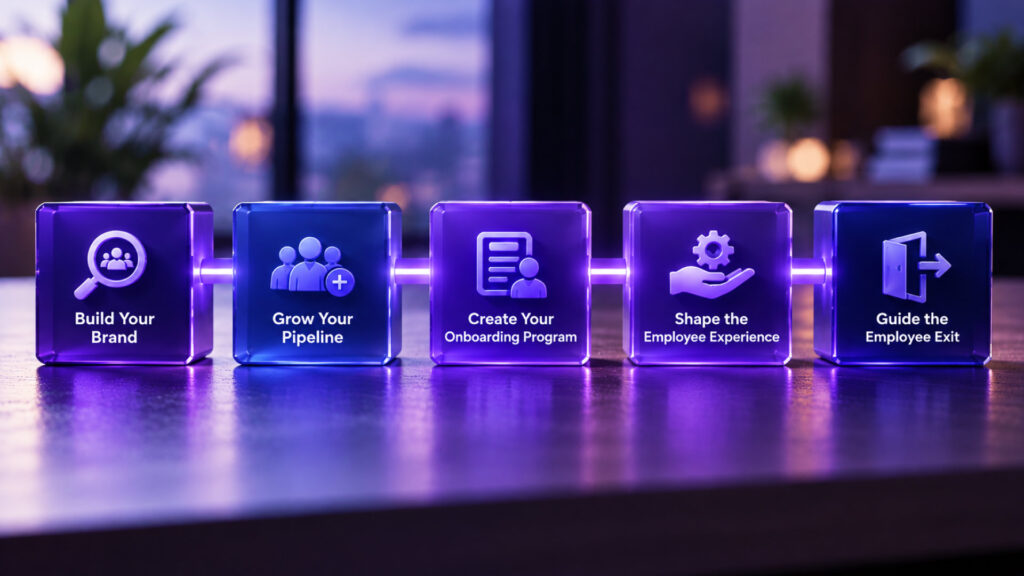
The five steps of the Designed to Care framework
The Case for Acting Now
The window for building this kind of organization is closing faster than most leaders realize. Every month that passes without investment in leadership development, EQ infrastructure, and people-first AI adoption is a month your competitors are getting ahead.
Here is why urgency matters.
The talent market rewards early movers. Organizations that build Designed to Care cultures now are attracting the best people from organizations that have not. This is a compounding advantage. Great people attract great people. The flywheel accelerates. Starting late means competing against organizations that have already built the team you want.
AI adoption accelerates. The pace of AI deployment is not slowing down. Every quarter brings new tools, new capabilities, and new competitive pressure to adopt. Organizations that have not built the leadership infrastructure to support AI adoption will fall further behind with each wave. The gap between “AI-ready” and “AI-struggling” organizations widens every month.
Trust compounds. Trust is built through consistent behavior over time. Organizations that start building trust now will have a deep reservoir when the next disruption arrives. Organizations that wait will be starting from zero when they can least afford it.
This is the synthesis of everything we have covered across September and October. The manager problem is the root cause. Carefrontational leadership is the skill. Leadership development systems are the infrastructure. And the IQ x EQ x AI equation is the framework that ties it all together.
Care is not a sentiment. It is a strategy. And the organizations that treat it as infrastructure will be the ones standing when the AI era sorts out the winners from the rest.
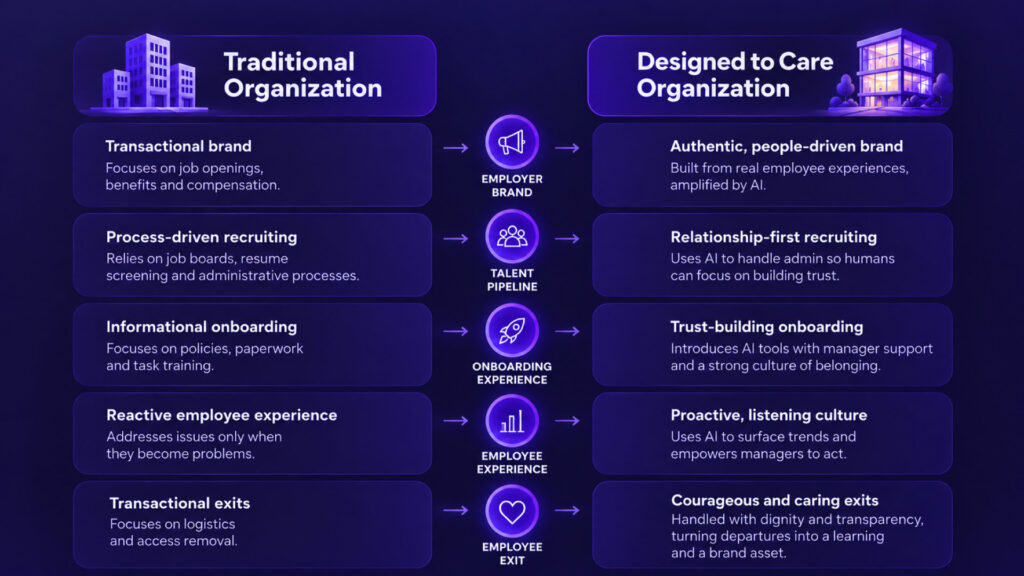
Comparison between a traditional organization and a Designed to Care organization
FAQ
Q: We have not done any of the foundational work. Is it too late to start?
It is never too late, but the cost of delay is real. Start with the highest-impact, lowest-effort change: protect four hours per week on every manager’s calendar for leadership activities. Then add one-on-one coaching conversations. Then build from there. The Designed to Care framework is designed to be adopted incrementally. You do not need to transform overnight. You need to start.
Q: How do we prioritize between AI adoption and people development when our budget is limited?
This is a false choice, but it is the most common one I encounter. The question assumes that AI adoption and people development are competing priorities. They are not. People development IS the AI adoption strategy. Every dollar you invest in manager development, EQ coaching, and leadership systems accelerates AI adoption by building the trust and capability that adoption requires. Reframe the budget conversation: you are not choosing between technology and people. You are choosing between technology that gets adopted and technology that sits on a shelf.
Q: What is the single most important thing we can do this quarter to move toward a Designed to Care organization?
Develop your managers. Not with a training event. With ongoing coaching, clear leadership expectations, and measurement of team-level outcomes. If your managers can lead, everything else follows: AI adoption accelerates, retention improves, engagement rises, and your employer brand strengthens from the inside out. If your managers cannot lead, no amount of technology, strategy, or branding will compensate. Start with the managers.