Why AI Implementation Fails When Managers Cannot Lead

Your company just invested six figures in an AI platform. The executive team is excited. The board is watching. The technology works beautifully in the demo environment.
Six months later, adoption is at 30%. The teams that were supposed to be transformed are still doing things the old way. And leadership is wondering what went wrong.
Here is what went wrong: you gave your managers a technology mandate without giving them the leadership capability to execute it.
In our recent post this month, I laid out why AI adoption is fundamentally a people challenge, not a technology one. This post goes to the specific point of failure: the manager.leader. Because in most organizations, the manager is where AI initiatives go to die. Not because managers are incompetent or resistant. But because they are being asked to lead the most complex transformation most of them have ever faced, with the same skills they have always had, in an environment that was already overwhelming them before AI arrived.
Last month, we spent four weeks exploring the manager problem. We showed why leaders get stuck in firefighting mode. We introduced carefrontational leadership as the skill that integrates authenticity and care. And we argued that organizations need to stop training managers and start developing leaders.
Now add AI to that picture. The managers who were already overwhelmed by the demands of leading people are now expected to also lead those same people through a transformation that threatens to redefine their roles. The math does not work. Unless you change the equation.
Why Are Leaders the Bottleneck in AI Adoption?
Because managers are the translation layer between strategy and execution. When leadership announces an AI initiative, it is the manager who has to explain what it means to the team, address their concerns, support the transition, and maintain performance through the disruption. If the manager cannot do those things, the initiative stops at the team level.
This is not a new dynamic. Managers have always been the point where organizational strategy either becomes reality or gets lost. But AI makes the stakes higher for three reasons.
First, AI requires managers to address emotional resistance, not just operational change. When you rolled out a new CRM, people grumbled but learned it. The CRM did not threaten their professional identity. Employees are asking themselves whether they are being upskilled or phased out. That question requires an emotionally intelligent response. A manager who can only give operational answers (“here is how to use the tool”) without addressing the emotional subtext (“here is why your role still matters”) will lose their team’s engagement.
Second, AI adoption requires experimentation, and experimentation requires trust. AI tools are not plug-and-play. They require people to try new workflows, fail, adjust, and try again. That kind of experimentation only happens in environments where people trust that failure will not be punished. And that trust is built or destroyed by the manager’s daily behavior. A manager who has never built a coaching culture cannot suddenly create one when AI demands it.
Third, AI changes what managers themselves need to be good at. The manager’s own role is changing. The administrative and analytical tasks that consumed much of a manager’s time are increasingly handled by AI. What remains is the work that requires human judgment, emotional intelligence, and leadership: coaching, conflict resolution, strategic thinking, and team development. In other words, the exact skills that most managers were never developed in.
Key takeaway: Managers are the bottleneck because AI demands the one thing most managers weren’t equipped to provide: human leadership. The organizations that develop their managers as leaders first are the ones where AI adoption takes hold.
What Does AI Anxiety Look Like on a Team?
AI anxiety does not announce itself. It looks like disengagement, passive resistance, and a quiet erosion of trust. Leaders who cannot recognize these signals will miss the adoption problem until it is too late to fix.
Here is how AI anxiety shows up in practice.
Selective adoption. Teams adopt the parts of the AI tool that feel safe and ignore the parts that feel threatening. They use it for simple tasks that do not challenge their existing workflow but avoid the features that would actually transform how they work. On a dashboard, this looks like adoption. In practice, it is avoidance.
Increased defensiveness about “how we have always done it.” When people feel threatened, they cling to the familiar. You will hear team members advocate passionately for processes that they never cared about before. This is not stubbornness. It is self-preservation. The old process is known, controllable, and does not threaten their value.
Silence in meetings. Just like the high performers we described in September who go quiet before they leave, employees experiencing AI anxiety stop contributing in the spaces where AI is discussed. They do not push back openly. They disengage. They wait to see what happens. This silence is often misread by leaders as acceptance. It is the opposite.
An increase in “Is my job safe?” questions, often asked indirectly. Employees rarely ask about job security directly. Instead, they ask about timelines: “When is this rolling out?” About scope: “Which departments are affected?” About precedent: “Has anyone been let go because of this?” Each of these questions is a proxy for the real question: should I be worried?
Voluntary turnover among your strongest performers. Your best people are also the most marketable. When they sense that an AI transition is being managed poorly, they do not wait to see how it plays out. They start looking for organizations where they feel more valued and more secure. You will not connect their departure to AI because they will not cite it in their exit interview. They will say “better opportunity,” and they will mean it.
Key takeaway: AI anxiety is invisible on dashboards and adoption metrics. It shows up in behavior, and only managers with strong EQ can read it. This is why manager development is not a nice-to-have for AI readiness. It is a prerequisite.

What Is the Cost of an AI Rollout That Stalls?
The cost is not just the technology investment. It is the compounding loss of trust, talent, and competitive position that accumulates every month the initiative underperforms. And unlike the technology spend, these costs are rarely tracked.
Let me put specific numbers to this.
Direct technology cost. Mid-market companies typically invest $100,000 to $500,000 in enterprise AI tools in the first year, including licensing, integration, and training. When adoption stalls at 30%, roughly 70% of that investment is generating no return. That is $70,000 to $350,000 in unrealized value, per year.
Productivity drag. A stalled AI initiative is worse than no AI initiative at all. Teams operating in a hybrid state, partly manual, partly automated, with inconsistent adoption, are less efficient than they were before. They are maintaining two systems, attending training they are not applying, and spending energy managing the confusion. One study from Accenture research has found that organizations stuck in early AI adoption phases often see net productivity decline before it eventually improves, as teams manage the burden of parallel systems while adoption remains incomplete.
Trust erosion. Every failed or stalled initiative erodes employee trust in leadership’s ability to manage change. This trust deficit does not stay contained to the AI project. It bleeds into every future initiative, every organizational change, every ask for employee buy-in. The compound effect is an organization that becomes progressively harder to lead because the workforce has learned that leadership announces transformation but cannot deliver it.
Talent loss. As discussed above, your strongest performers are the first to leave when they lose confidence in leadership’s ability to manage change. The replacement cost for mid-level employees (50% to 200% of salary, per Gallup) is real, but the strategic cost is even higher: you are losing the people who could have been your AI champions.
What is disengagement costing you during your AI transition? Use our Cost of Disengagement Calculator to quantify the financial impact of stalled adoption and employee anxiety. The numbers will reframe how you think about your leadership development budget relative to your technology budget.
Key takeaway: A stalled AI initiative does not just waste the technology investment. It creates a trust deficit that makes every future change harder. The cost compounds every quarter, and it is almost entirely attributable to the leadership gap, not the technology gap.
How Do You Build an AI-Ready Management Team?
By investing in the same leadership competencies that solve every other people challenge: the CARE model. Courage, Authenticity, Relationship, and Empathy are not just good leadership principles. They are the specific capabilities that determine whether your managers can lead their teams through AI adoption.
Here is how each competency maps to AI readiness.
Courage in the AI context:
- Having honest conversations about which roles will change
- Acknowledging uncertainty instead of pretending to have all the answers
- Making the case to senior leadership for investment in people, not just tools
- Addressing AI anxiety directly instead of hoping it goes away
Authenticity in the AI context:
- Setting clear, measurable adoption milestones for each team
- Following through on commitments to reskilling and support
- Holding the organization accountable for the people-first narrative
- Tracking adoption at the behavioral level, not just the license level
Relationship in the AI context:
- Understanding each team member’s specific concerns about AI
- Knowing who is excited, who is anxious, and who is quietly disengaging
- Building one-on-one coaching conversations around the AI transition
- Creating team-level forums where concerns can be voiced without judgment
Empathy in the AI context:
- Recognizing that AI anxiety is legitimate, not a sign of resistance
- Understanding that this transition is harder for some people than others
- Supporting people through the emotional dimension of change, not just the operational one
- Treating people who struggle with adoption as humans to be developed, not problems to be managed
The development pathway is the same one we outlined in September’s leadership development system: selection, onboarding into leadership, ongoing coaching, environmental reinforcement, and measurement. The only difference is that AI literacy becomes a baseline requirement for every manager, alongside the CARE competencies.
“AI may change how work gets done, but it doesn’t change what people need from their leaders. They still need courage, authenticity, relationships, and empathy—and the faster technology moves, the more intentionally we have to lead with CARE.”
Key takeaway: An AI-ready management team is a well-developed management team. The CARE competencies that solve the manager problem also solve the AI adoption problem. If you invested in leadership development in September, you are already ahead. If you did not, start now, because AI will not wait.
What Should an AI Leadership Playbook Look Like?
It should be simple, actionable, and anchored in the same principles that guide every other leadership practice in your organization. AI does not require a separate leadership philosophy. It requires your existing leadership philosophy to be strong enough to absorb a new challenge.
Here is a framework your managers can use starting this week.
Week 1: Listen. Before you talk about AI, listen. Schedule one-on-ones with every team member. Ask three questions: What have you heard about AI in our organization? What excites you about it? What concerns you? Do not defend, explain, or reassure. Just listen. The patterns in those responses will tell you exactly what your team needs.
Week 2: Communicate honestly. Based on what you heard, address the team as a group. Share what you know about the organization’s AI plans. Be honest about what you do not know. Name the concerns you heard (without attributing them) and address them directly. Commit to ongoing communication as the situation evolves.
Week 3: Create space for experimentation. Identify one low-stakes use case where the team can experiment with AI tools. Make it clear that this is exploration, not evaluation. No one will be judged on how quickly they adopt. The goal is learning, and learning requires the freedom to fail.
Week 4: Check in and adjust. Follow up individually and as a team. What worked? What felt uncomfortable? What do people need from you to continue engaging with AI? This follow-through is where most managers fail, and it is where the trust is actually built.
Ongoing: Repeat. AI adoption is not a sprint. It is an ongoing leadership practice. The managers who succeed are the ones who keep listening, keep communicating, and keep creating space for their teams to grow through the change.
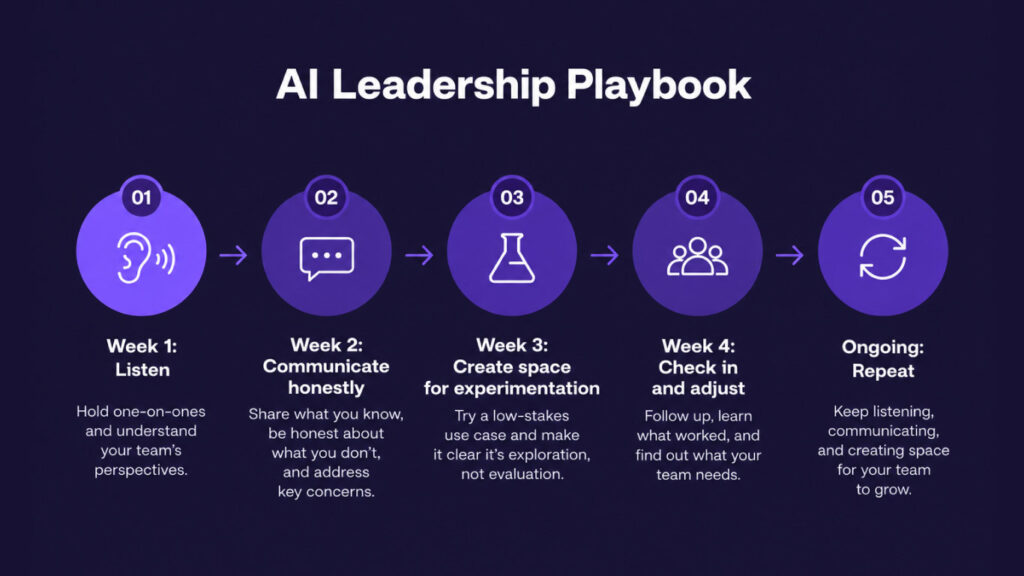
This framework works whether your organization is in the early stages of AI exploration or deep into implementation. Because the principles are not AI-specific. They are leadership fundamentals applied to a new context.
FAQ
Q: What if our managers are themselves anxious about AI?
They probably are, and that is normal. Managers are employees too, and their roles are changing just as significantly. The solution is to develop your managers first. Give them AI literacy so they understand what is coming. Give them leadership coaching so they can process their own anxiety before they are asked to manage their team’s anxiety. A manager who has not been supported through the change cannot support anyone else through it.
Q: How do we measure whether our managers are effectively leading AI adoption?
Track three things: team-level adoption rates (are their teams using the tools?), employee sentiment about the AI transition (are people feeling supported?), and voluntary turnover during the transition period. If a manager’s team has low adoption, low sentiment, or high turnover, the bottleneck is likely leadership, not technology. Use those signals to target coaching and support.
Q: Should AI training come before or after leadership development?
After, or simultaneously. If you train managers on AI tools before developing their leadership capability, they will teach their teams how to use the tools but fail to address the human side of the transition. If you develop leadership first, managers can apply those skills immediately when AI training begins. The ideal is a development program that integrates AI literacy with leadership coaching.
Q: What do we do if a manager is resisting AI themselves?
Apply carefrontational leadership. Have a direct, caring conversation. Name the resistance. Understand what is driving it. Is it fear? Lack of understanding? Legitimate concern about the tool’s value? Each of those requires a different response. Some managers will come around with support. Others may not be the right leaders for an AI-driven environment, and that conversation, handled with care, is also part of leadership.