Why Do Good Employees Leave? Your Best People Are Carrying Your Weakest, and They’ve Noticed

The person you were counting on to help run this place in five years walks in and gives notice. You’re genuinely surprised, and when you mention it to the people who worked alongside them, nobody else is. Then the exit interview turns out to be the first fully honest conversation anyone has had with that person in two years.
If that scene feels familiar, you’re not alone, and you’re not unlucky. Top performers almost never leave over a single bad day; they leave over an experience that told them, a little at a time, that the effort they were putting in was not being seen, and that the people around them weren’t being asked for the same.
This is the second of the three problems we’ve been working through this month. The pillar piece explains why hiring, retention and performance share one cause, and last week we looked at the front door. This week is about the people already inside it.
Why Do Top Performers Really Quit?
Not for the reason they put in the resignation letter. “A better opportunity” is true, but it’s the last link in a chain that usually started with how they were led.
When I wrote Solve the People Puzzle, the reasons people gave for being unhappy at work were an unlikeable boss, a lack of empowerment, internal politics and a lack of recognition, and money wasn’t on the list. By the time I wrote Dare to Care in the Workplace I put it more bluntly: the number one reason people leave companies is because they do not feel like they are appreciated. If people don’t get recognition from you, they will leave and find it elsewhere, and recognition costs almost nothing to give.
Here is what pushes strong people out, in the order I see it most:
- They’re carrying someone else. Your strongest people know exactly who isn’t pulling their weight, and every month a leader avoids that conversation, the high performer concludes that effort and results don’t matter here.
- Nobody has asked them about their future. They’ve stopped hearing anything about where they’re headed, so they start imagining it somewhere else.
- They don’t feel trusted. Being watched, second-guessed or denied reasonable flexibility tells a capable adult that the organization doesn’t trust them, and they notice.
- Their work goes unthanked. Not unpaid; unthanked. The person who saves the quarter hears nothing, and they remember.
Flexibility is a trust signal, not a perk
I tell a story from Solve the People Puzzle about the CFO of a $150 million company with an eighty-person sales force. They were about to move into a larger, more expensive building, and I suggested letting the sales team work virtually instead. His answer was, “No, because I don’t trust them.” What I wrote then is what I’d tell every leader now: if the CFO doesn’t trust his sales force, I am certain none of those eighty salespeople trust him either. As I put it to a group of leaders this fall, the more flexibility you can give the people who work with you, the more it says, I trust you, and the less you give, the more it says, I don’t. It’s really adulting in the workplace.
Key takeaway: top performers leave over the accumulated experience of being led, carried by the weakest link on the team and left unthanked. Almost every one of those causes sits within a leader’s control.

Why Is a Quiet Job Market Hiding Your Turnover Risk?
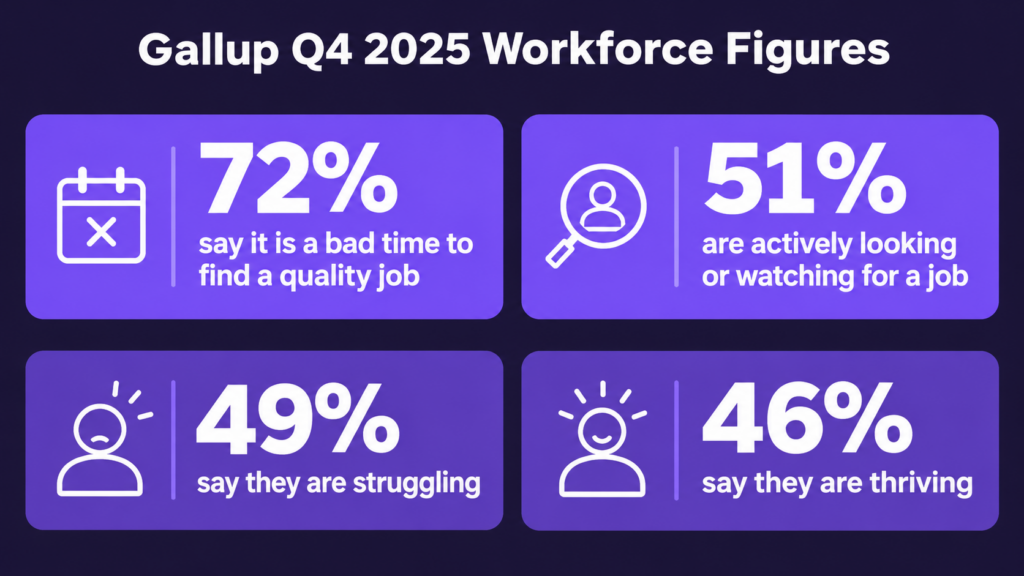
Because your people are staying for now, not staying for good. Gallup’s research from late 2025, published in March 2026, found that 72% of U.S. workers think it’s a bad time to find a quality job, and yet 51% are actively looking or watching for one anyway. Engagement sits at 31%, the lowest in a decade, and for the first time in Gallup’s tracking more workers say they’re struggling (49%) than thriving (46%).
Put those together and you get a workforce that is quietly waiting. When the market turns, the people with the most options will move first, and those are exactly the people you can least afford to lose.
Find out where your people are quietly leaking. The free five-minute assessment scores your organization across the five stages where companies lose people and shows you where to focus first. Take the free assessment.
There’s one more number worth a leader’s attention. Gallup’s State of the Global Workplace: 2026 Report found that engagement among people who lead teams fell from 27% to 22% in a single year. The people your top performers report to are tired too, and a tired leader is far less likely to notice the signals until the resignation arrives.
Key takeaway: low turnover in a cautious market is a reprieve. Leaders who use it to fix the experience will keep their best people when the market opens; leaders who read silence as satisfaction will be refilling the seats.
Do Counteroffers Work?
Rarely, and almost never for long. In my experience, and as I wrote in my first book, people who accept a counteroffer usually still leave within a year, because the counteroffer addresses the money and leaves untouched every reason they started looking.
Counteroffers are usually a desperation plea on the employer’s side, and a counteroffer also sends a message to everyone watching: that the way to be valued here is to threaten to leave. That’s a lesson your other strong performers learn quickly, and it’s the opposite of the culture most leaders say they want.
The better question isn’t “what will it take to keep you?” asked after the resignation. It’s the question asked months earlier, while the answer can still change something.
How Do You Know Your Best People Are About to Leave?
You ask, early and often, and you listen past the first answer. The signals are almost always there before a resignation; most leaders simply aren’t positioned to hear them.
Listen past the first answer
One of the stories leaders remember from Dare to Care is about a client of mine in Ohio I call Mr. Jones, who was furious that one of his top salespeople took a sales call while out walking the dog. When I took the time to listen and explore the why behind his reaction, it turned out the dog walk was never the real issue: Mr. Jones had never been able to walk his own dog during the workday, and he was both jealous and confused about the new norms of working from home. Once he felt heard, he moved past the anger and set up clear guidelines for his team. When someone brings you a complaint, or when you bring one yourself, the issue raised is rarely the whole issue, and leaders who stop at the first answer miss the one that matters.
Two questions, every week
Marcus Buckingham’s two questions are the simplest retention tool I know, and I use them in nearly every workshop: “What are you working on?” and “How can I help you?” Asked weekly, by the person’s own leader, they surface frustration while it’s still small, and they tell the high performer, in the plainest terms, that someone is paying attention.
Stop making your best people carry the rest
The hardest part of keeping strong people is dealing with the people they’re carrying. We spent all of August on this, and the lesson holds: avoiding hard decisions hurts your best people, and how you handle a departure is something everyone who stays learns from watching. In Dare to Care I call this Fit to Quit: if people don’t fit you, they are going to quit you, so invite them to leave before productivity or morale is damaged. Helping someone exit well is a leadership skill, and it protects both the person leaving and the team that stays.
Key takeaway: resignations rarely come out of nowhere. Leaders who ask the two questions weekly, listen past the first answer and stop asking their strongest people to carry the rest see the signals in time to act.
Keep Your Best People Through 2027
The leaders who keep their best people next year will be the ones who designed for it this winter. The Employee Experience Masterclass works through every stage of that design, one month at a time, in a small group of leaders solving real problems in their own companies, and the next cohort begins in January 2027.
The best way to know if it’s right for you is to see it. Claim a complimentary visitor’s pass and join a live session as my guest: no obligation, no credit card, and if it isn’t for you, you’ll know inside ninety minutes. Claim your visitor’s pass.
If you’d rather talk first, reach out to me directly and tell me what’s happening on your team.
FAQ
Q: Why do good employees leave even when they’re paid well?
Because pay is rarely the reason strong people start looking. They leave for the leader they work for, for a lack of recognition, for carrying weaker teammates and for not hearing anything about their own future. Pay matters, but it seldom fixes any of those.
Q: Should I make a counteroffer to keep someone?
Usually not as a first resort. People who accept counteroffers often leave within a year anyway, because the reasons they started looking haven’t changed, and the counteroffer teaches everyone else that threatening to leave is how you get noticed.
Q: How can I tell if a top performer is about to quit?
Watch for someone who goes quiet in meetings, stops volunteering ideas or stops talking about the future. The most reliable way to know is to ask: weekly conversations about what they’re working on and how you can help surface problems while they can still be solved.
Q: Isn’t our low turnover this year proof that retention is fine?
Not on its own. Gallup found that 72% of U.S. workers believe it’s a bad time to find a quality job while 51% are still looking or watching. Some of today’s retention is people waiting for a better market.