Can’t Find, Keep or Grow Good People? It’s One Problem

Most of the leaders I sit with carry three complaints into the room, usually in this order: they can’t find the right people to hire, they can’t keep their best employees once they have them, and the people who stay aren’t performing the way the leader knows they could. They describe these as three separate headaches, and they budget for them that way, with a recruiting line, a retention program and a training calendar that rarely talk to each other.
I’ve been in this work since 1985, and after more than a thousand companies I’ve stopped believing they’re three problems. They’re one problem showing up in three places, and it usually isn’t the one anyone has been budgeting for.
The problem is design. Somewhere along the way the organization decided how it would treat its customers, deliberately and in detail, and left the experience of its own people to chance. Candidates feel that before they apply, new hires feel it in their first ninety days, and your strongest people feel it every Monday morning. As I wrote in Dare to Care in the Workplace, put people first, and all else follows; the reverse is also true, and most leaders are living inside the reverse.
This piece lays out why the three problems share one cause, what the current data says about where your people really stand, and what a leader can do before January to start designing for people to stay.
Why Do the Same Companies Struggle to Hire, Keep and Grow People?
Because all three run through the same pipe. A company’s reputation as an employer, the way it brings people in, the way it leads them day to day and the way it lets them go are one continuous experience from the employee’s side, even when the org chart splits it across four departments. When that experience was never designed, it leaks in all three places at once.
Here is how the single cause shows up as three symptoms:
- You can’t find the right people. Your reputation as an employer is already doing your recruiting, and you didn’t write it. Good candidates read the reviews, talk to people who used to work for you and notice how long it takes you to call them back, and the best of them have options.
- You can’t keep your best employees. The person you were counting on gives notice, and you’re surprised while nobody who worked for them is. Top performers rarely leave over one bad day; they leave over an experience that told them, a little at a time, that no one was paying attention.
- The people who stay aren’t performing. Your strongest people end up quietly carrying your weakest, everyone knows it, and the leader who never had the hard conversation calls the resulting silence alignment.
When leaders treat these separately, they spend money on the symptom that is loudest that quarter. They pay a recruiter to refill a seat that a better first ninety days would have kept full, or they buy a training program for a team whose real issue is a supervisor nobody has developed. I call that pouring water into a bucket with holes in the bottom, and then wondering why it never fills.
Find out which one is costing you most. Our free assessment takes about five minutes and scores your organization across the stages where companies lose people, from the reputation candidates see to the way you handle the day someone leaves. Take the free assessment.
Key takeaway: hiring, retention and performance problems are three readings from the same instrument. Fix the experience your people move through, and all three readings improve together.
What Is the Data Telling Leaders Right Now?
That your people are quieter than they are content, and those are not the same thing. The current numbers describe a workforce that is staying put because the job market feels risky, not because the work feels good, which means a lot of the retention leaders are feeling right now is borrowed.
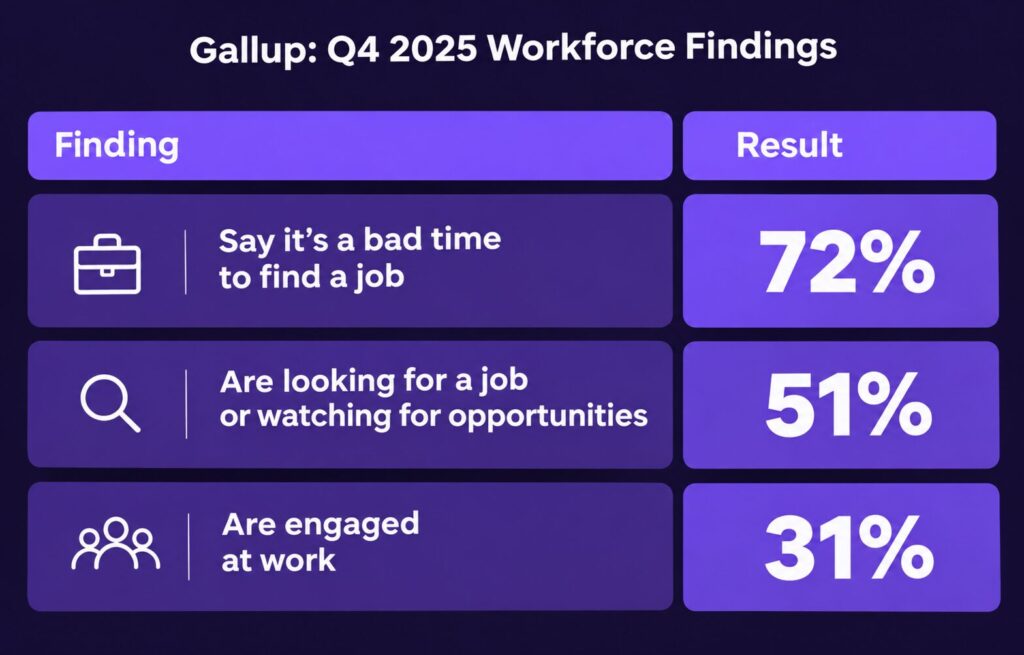
Gallup’s most recent U.S. workforce research, published in March 2026 from its fourth-quarter 2025 survey of more than 22,000 workers, makes the point plainly:
| What Gallup found (U.S. workers, Q4 2025) | What it means for a leader |
| 72% say it’s a bad time to find a quality job | People who want to leave may be waiting rather than leaving |
| 51% are actively looking (11%) or watching for opportunities (40%) | Half your workforce has one eye on the door |
| 31% are engaged at work, the lowest level in a decade | Most of the payroll is showing up without bringing its best |
| 49% are struggling and 46% are thriving | For the first time in Gallup’s tracking, more workers are struggling than thriving |
Globally the picture is similar. Gallup’s State of the Global Workplace: 2026 Report found that only 20% of employees worldwide were engaged in 2025, and it estimates the cost of low engagement at roughly $10 trillion in lost productivity, about 9% of global GDP. The finding that matters most for this conversation is about the people in the middle of your organization: engagement among those who lead teams (Gallup’s term is managers) fell from 27% to 22% in a single year, and Gallup attributes most of the overall decline to that drop.
The quiet market is not loyalty. When 72% of workers think it’s a bad time to look and 51% are looking anyway, the turnover you aren’t seeing this year is turnover you are scheduling for next year. The leaders who use this window to redesign the experience will keep their people when the market opens up; the ones who mistake silence for satisfaction will be refilling seats.
Key takeaway: low turnover in a cautious job market is a reprieve, not a result. The data says your people are waiting to see what you do with it.
Why Isn’t This an HR Problem?
Because the experience your people have is set by the leaders they work for every day, and HR doesn’t sit in those meetings. HR can design a beautiful onboarding plan, a fair review process and a thoughtful exit survey, and every one of them will succeed or fail depending on the person who runs the team.
In Solve the People Puzzle I borrowed a distinction from Curt Coffman that I still use in nearly every keynote: there is the Big C culture of an organization, its mission, vision, values and strategy, and there is the Little C culture, the local culture each supervisor creates in their own corner of it. As I wrote then, the real culture of an organization is only as big as a single person or a supervisor’s domain. Your values statement says one thing; what a twenty-six-year-old learns on a Tuesday afternoon from the person they report to says the other, and the second one wins.
One newer client told me he had spent $700,000 working on employee experience with outside HR strategists, and nothing changed. I don’t doubt the strategists were capable. The work was aimed at programs, though, and the people who actually shape the experience, the leaders running teams, were never asked to change how they lead.
This is also why I keep saying that leaders either design for trust or they design for fear. There isn’t a neutral option, and the default isn’t neutral either, because an experience nobody designed still teaches people something; it just teaches them whatever the most stressed leader in the building happens to model that week.
If you work in HR, none of this lets you off the hook, and none of it should land on you alone. You’ve likely been carrying this upstairs by yourself for a while. The most useful thing you can do is bring an executive into the work with you, because the change has to be owned by the people with the authority to make it.
“CEOs, you cannot delegate your culture to HR and then wonder why your people aren’t performing. HR can create the programs, but your leaders create the experience your employees live every single day. If you want to attract better people, keep your best people, and improve performance, stop treating employee experience as an HR project. It’s a leadership decision—and it starts with you.”
Key takeaway: HR can build the tools, but leaders deliver the experience. Until the leadership team owns it, the organization is funding programs and hoping for culture.
What Does an Organization Designed to Care® Actually Do Differently?
It treats the full arc of employment as one system and designs each stage on purpose. The Designed to Care® framework breaks that arc into five stages, and the organizations that keep their best people are rarely brilliant at one stage while ignoring the rest; they are deliberate at all five.
The Employee Experience Journey
Five stages that shape how employees experience your organization.
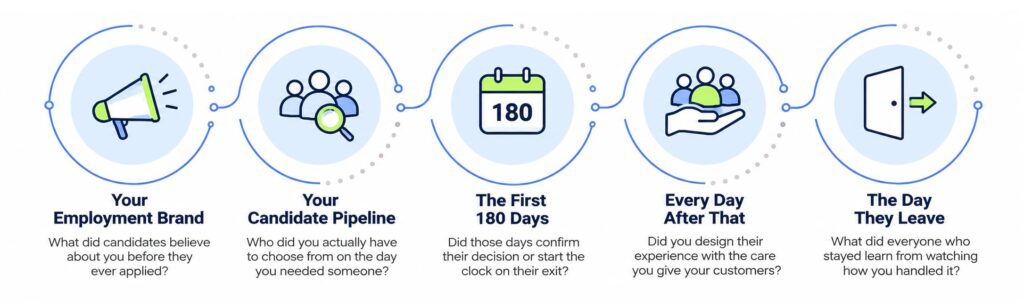
01 — Your Employment Brand. Before they apply.
What did candidates believe about you before they ever applied?
EXPLORE THIS STAGE: Recruiting spend as a leadership report card →
02 — Your Candidate Pipeline. Before you hire.
Who did you actually have to choose from on the day you needed someone?
03 — The First 180 Days. The beginning of employment.
Did those days confirm their decision or start the clock on their exit?
EXPLORE THIS STAGE: Onboarding as trust infrastructure →
04 — Every Day After That. The ongoing experience.
Did you design their experience with the care you give your customers?
EXPLORE THIS STAGE: Leadership listening systems →
05 — The Day They Leave. The final impression.
What did everyone who stayed learn from watching how you handled it?
EXPLORE THIS STAGE: Exits are culture moments →
Employees are your internal customers
The simplest test I know comes from Dare to Care: treat your employees as internal customers. Most companies can tell you their customer acquisition cost, their retention rate and the three moments that make or break a client relationship, yet the same companies can’t name the three moments that make or break an employee’s first year. If you would never treat a client the way you treat your people, something in the design is broken.
It’s not bout the beer
Perks don’t fix this, and they never did. Years ago, at a Vistage meeting, a CEO asked me whether his beer tap and foosball table would attract people. “It’s not about the beer,” I told him. “It’s about how you treat people and the experience they have working in your organization.” The line still gets a knowing laugh in every room, because everyone has worked somewhere with a foosball table and a supervisor nobody trusted. Perks decorate an experience; they don’t design one.
Care still needs strategy
This is where the equation I teach, IQ x EQ x AI, = Designed to Care® earns its place. The intelligence to build the system and the emotional intelligence to lead people through it have to multiply together, and the tools you add on top only amplify whichever of the two you actually have. When care is treated as a mood instead of infrastructure, it disappears the first quarter the numbers get tight.
Key takeaway: the organizations that keep their best people design all five stages on purpose and measure them the way they measure the customer experience.
Where Should a Leader Start Before January?
Start by finding out which of the three problems is costing you most, then put one stage of the experience on your 2027 plan with the same seriousness as your revenue targets. You don’t need a new department for this; you need about an hour with your leadership team and the willingness to hear the answers.
Here is a short checklist to work through before your 2027 planning is final:
☐ Count the departures. How many people left voluntarily in the last twelve months, and how many of them were people you wanted to keep?
☐ Ask why the last three really left. Not the exit-interview reason; the reason a trusted colleague would give you over coffee.
☐ Read your own reviews. Look at what candidates and former employees say about you online, because the people you most want to hire already have.
☐ Ask Marcus Buckingham’s two questions. Have every leader on your team ask each person who reports to them, every week: “What are you working on?” and “How can I help you?” The ones who can’t find the time for that are telling you where your Little C culture is weakest.
☐ Name the person carrying the team. Identify who is quietly doing more than their share, and decide what you will do about the person they are carrying.
☐ Pick one stage for Q1. Brand, pipeline, first 90 days, every day after, or the exit. One, with an owner and a date.
If you work through that list honestly, you will know more about your talent risk than most annual plans ever capture.
Start 2027 With a Plan for Your People
Every January, leadership teams write goals for revenue, margin and growth, and almost none of them write a plan for the people who are supposed to deliver it. Then, around March, a critical project slips and the best person on it gives notice, and the pattern repeats.
The KQV Designed to Care® Masterclass exists to break that pattern. It’s a small group of leaders working on their own companies rather than a case study, and our next cohort begins in January 2027.
You don’t have to commit to anything to see whether it fits. There are three ways in, and you can start wherever you’re comfortable:
- Take the free assessment. Five minutes, and you’ll know where you’re losing people. Take the assessment.
- Talk with me directly. Tell me what’s happening in your organization, and I’ll tell you what I see. Contact Kathleen.
In the coming weeks we’ll take the problems in turn: why you can’t find good people and what to do about it, and why your best people leave even when the market is quiet.
FAQ
Q: Why can’t I find good employees anymore?
Often because your reputation as an employer is working against you before you ever post the role. Candidates research companies the way buyers research products, and HireClix’s 2025 candidate experience research found that 57% of job seekers say reviews on sites like Glassdoor and Indeed influence whether they apply. If the best candidates are passing you by, look at what they can see about you before you look at your job description.
Q: Is low turnover this year a sign our retention is working?
Not necessarily. Gallup found in late 2025 that 72% of U.S. workers think it’s a bad time to find a quality job, while 51% are still looking or watching. Some of your current retention is people waiting for a better market, so measure how your people are actually experiencing work rather than only who has left.
Q: Who should own the employee experience, HR or the leadership team?
The leadership team owns it, and HR equips it. HR can design the tools and processes, but the experience itself is delivered by the leaders people work for every day, so the authority to change it has to sit with them.
Q: Where should a mid-sized company start if the budget is tight?
Start with the stage where you are losing the most. For many companies that is the first ninety days or the way leaders handle their strongest performers, and neither one requires a large budget; both require leaders who are willing to have honest conversations and to do it consistently.