Why Can’t You Find Good Employees? Start Treating Recruitment Like a Sales Process

“We just can’t find good people anymore.” I hear it from founders, from presidents of third-generation manufacturers and from CEOs of fast-growing service firms, and I understand why they say it. The role has been open five months, the bar has quietly been lowered twice, and the best candidate in the process took another offer before anyone had a chance to counter.
Here is the uncomfortable part: the good people are out there, and many of them would consider a move. They just aren’t choosing you, and the reasons usually have very little to do with the job description.
In last week’s piece I made the case that hiring, retention and performance are one problem showing up in three places. This week takes the first of those places, the front door, and looks at why so many leaders find it empty.
Why Are Good Candidates Passing You By?
Because most companies recruit the way they would never sell. They post a job, wait for applications and hope the right person happens to be looking that week, which is what I call Post and Pray, and Post and Pray is not a growth strategy.
In Solve the People Puzzle I argued that recruitment is a sales process, and nothing in the years since has changed my mind. You would never expect a major client to sign after one cold email, yet companies expect a strong performer to leave a secure job after one job posting. In the same way customers need to be contacted eight to twelve times before they make a buying decision, people who are employed somewhere else need eight to twelve contacts before they’ll move from a situation that feels secure to a new opportunity.
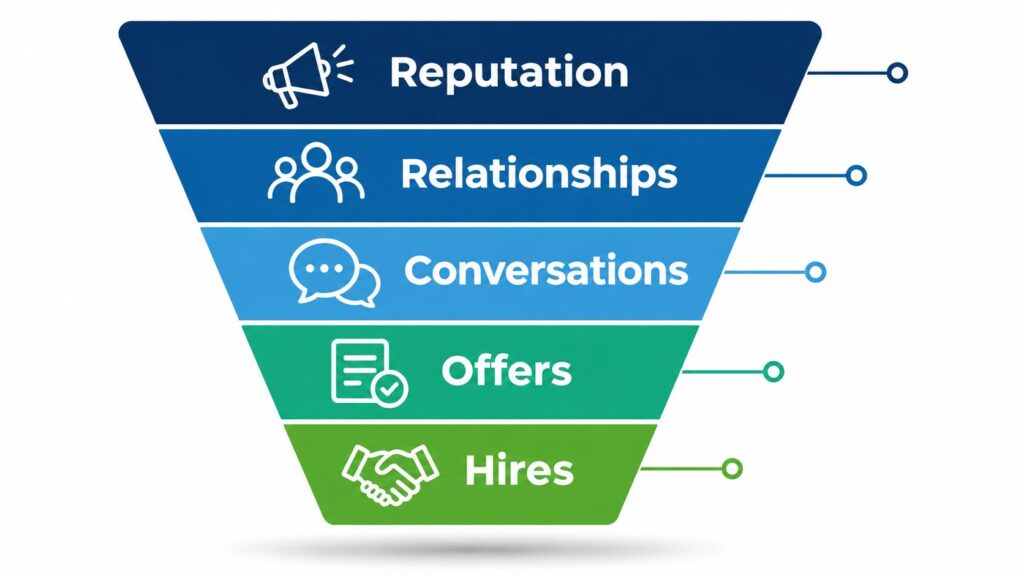
The companies that keep finding good people do a few things differently:
- They build relationships before the opening exists. Their leaders know the people they would hire tomorrow, by name, and stay in touch with them when nothing is open.
- They treat candidates like buyers. They respond quickly, explain the process honestly and follow up after every conversation, because a candidate’s experience of being recruited is their first experience of being led.
- They let go of the ego. A strong candidate has choices, and a company that assumes people are lucky to be considered will lose the ones who know they aren’t.
- They sell the work, not the perks. Meaningful work, a leader worth following and room to grow carry more weight than anything on the benefits page.
Your reputation is recruiting for you, or against you
Candidates research employers the way buyers research vendors. HireClix’s 2025 candidate experience research found that 57% of job seekers say reviews on sites like Glassdoor and Indeed influence whether they apply, which means a meaningful share of the people you want never reach your job post at all. They read what your former employees wrote and moved on.
That is why the most important recruiting asset you have isn’t your careers page; it’s the people who already work for you. Your employees are part of your brand, and what they say about working for you, at dinner, at their kid’s soccer game and online, is the marketing your best candidates actually believe.
Before you write the next job post, run the number. Our Cost of Vacancy Calculator shows what each open role is costing you in lost output and overtime while it sits empty. Most leaders are surprised by the monthly figure. Calculate your cost of vacancy.
A sales style funnel relabeled for talent reputation, relationships, conversations, offers, hires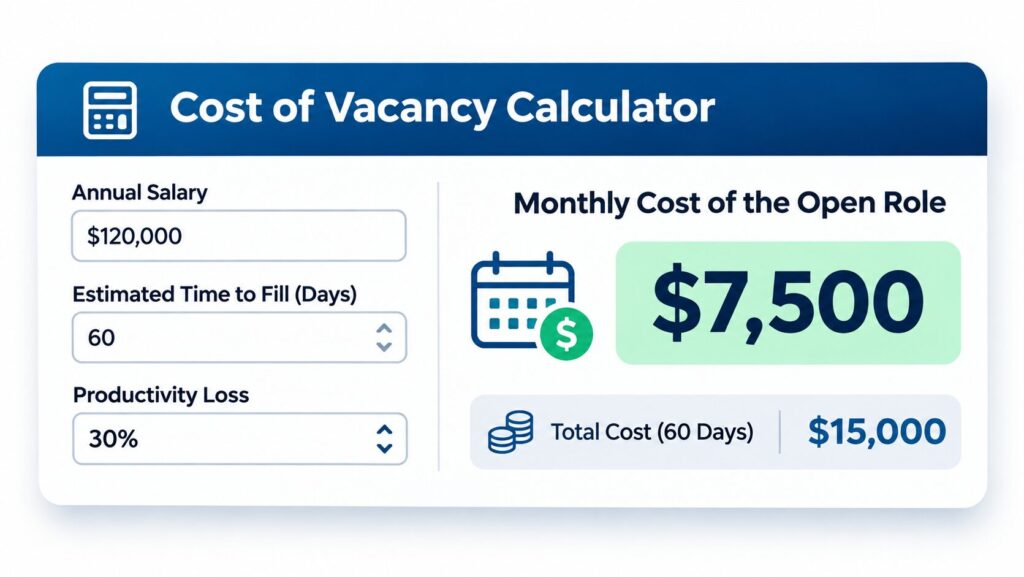
Key takeaway: the companies that “can’t find anyone” are usually the companies nobody is hearing good things about. Fix the reputation and the relationships, and the pipeline follows.
What Does an Open Role Actually Cost You?
More than the recruiting fee, and for longer than most leaders estimate. SHRM’s 2025 recruiting benchmarking puts the median time to fill a nonexecutive role at 39 calendar days, and that is the median: specialized, technical and leadership roles routinely run much longer, and every one of those days carries a cost.
While a critical seat sits empty, the cost shows up in places that never appear on a recruiting invoice:
- Work that doesn’t get done, or gets done slower, by people already stretched.
- Overtime and burnout for the team covering the gap, which is how one vacancy turns into two.
- Revenue you can’t take on, because you don’t have the people to deliver it.
- Leaders pulled into the work, doing the job of the person they haven’t hired instead of leading.
One of the stories from Solve the People Puzzle still captures how this feels from the inside. I was introduced to the senior director of human resources at a payments company that was struggling to attract the right people, and she opened our conversation with: “I can’t wait. I’m getting yelled at by the chief sales officer who thinks I should have these jobs filled now.” She was recruiting the company’s most valuable assets under pressure and without an effective process or strategy, so every opening started from zero, and the frustration landed on her.
Key takeaway: an open role isn’t a pause, it’s a cost that compounds. Leaders who can see the number tend to start building the pipeline before the next resignation.
Why Do Candidates Turn Down Your Offers?
Usually because something earlier in the process told them what working for you would feel like. By the time a candidate declines an offer, the decision was often made several conversations ago.
I wrote about a consulting firm in Austin that extended three offers to candidates we had presented, and all three were declined. The client was upset, understandably, and we had to go back and help them understand why those people said no. Was it culture, was it leadership, was it vision, was it compensation, or all of the above? Those are the questions I’d ask any leader in that position, and while compensation is the answer leaders reach for first, in my experience it is rarely the whole story.
Hiring is selection, not filling a seat
The language a company uses for hiring tells you a lot about how it hires. I’ve started using a different word for it, and I say this on stage often: “My word for hiring is selection. I’m selecting someone to come into my workplace to serve my customers. That’s a different conversation versus get somebody in, get a warm body in. And then we wonder why we have this churn.”
When leaders think in terms of filling seats, they hire for availability and move fast for the wrong reasons. When they think in terms of selection, they hire for character and culture first and competence second, because, as I wrote in my first book, you can teach the mechanical skills of a job, but you can’t teach ethics.
Turn the job request into a risk conversation
One reframe changes the quality of almost every hiring discussion I sit in. Instead of a leader saying “We need to hire a controller,” ask them to finish this sentence: “We are exposed because ______.” Exposed because one person holds all the institutional knowledge, because a retirement is eighteen months away with no successor, or because growth will outrun the team by the third quarter. That sentence turns hiring from a scramble into a plan.
Key takeaway: offers are won or lost long before the offer letter. Leaders who select rather than fill, and who plan for risk rather than react to vacancies, stop losing their best candidates at the finish line.
How Do You Build a Pipeline Before You Need It?
Treat talent the way your sales team treats revenue: as a pipeline you build and maintain every month, owned by leaders, not as a project HR launches when someone resigns. Building a candidate pipeline isn’t simply a recruiting task; it is a leadership lever for growth.
A practical starting point for the next ninety days:
- List your exposed roles. Identify the positions where a departure would hurt most: single incumbents with no backup, roles tied to next year’s growth plan and roles with heavy turnover.
- Name the people. For each exposed role, ask the leader who owns it to name three people outside the company they would hire tomorrow, and to stay in genuine contact with them.
- Activate your own people. Ask your strongest employees who they would want to work with again, and make referrals easy and appreciated.
- Fix the front door. Read your own reviews, apply to your own job and time how long it takes anyone to respond. Then fix what you find.
- Measure it like sales. Track touchpoints, conversations and conversion the way you would track a revenue pipeline, and review it in the same leadership meeting.
And remember the connection to everything that happens after the hire, in a line I’ve been using with leaders this year: retention sets the table for recruitment, the same way marketing sets the table for sales. If you can’t keep your team, you will have a harder time attracting new members of it, because the people who leave become the reviews the next candidate reads.
Want Help Building This Before January?
The first half of the Employee Experience Masterclass is built around exactly this problem: your employment brand, lead generation for talent, candidate engagement, screening and assessment, precision interviewing and the offer. It runs as a small group of leaders working on their own companies, and the next cohort starts in January 2027.
- Not sure where you’re losing people? Take our free five-minute assessment and see which of the five stages is costing you most. Take the assessment.
Next week, we turn to the second problem: why your best people leave even when the job market is quiet.
FAQ
Q: Why can’t I find good employees when unemployment isn’t especially high?
Because the people you want usually aren’t looking for you; they’re employed and cautious. Gallup found in late 2025 that 72% of U.S. workers say it’s a bad time to find a quality job, so strong candidates move only when a company has earned their attention through relationships and reputation, not through a job post alone.
Q: How long should it take to fill a position?
SHRM’s 2025 recruiting benchmarking reports a median of 39 calendar days to fill nonexecutive roles. Leadership and specialized roles take longer, which is why the pipeline for those roles has to exist before the vacancy does.
Q: Do online reviews really affect who applies?
Yes. HireClix’s 2025 research found that 57% of job seekers say reviews on sites like Glassdoor and Indeed influence their decision to apply. Your current and former employees are writing your recruiting copy whether you engage with it or not.
Q: What does “recruitment is a sales process” actually mean?
It means treating candidates the way you treat prospects: building relationships before there’s an opening, expecting several meaningful touchpoints before someone in a good role will consider a move, following up consistently and measuring the pipeline the way you measure revenue.