The Skills Your AI Strategy Is Missing: EQ in the Age of Automation

Here is an irony that most leadership teams have not yet reckoned with: the more your organization invests in artificial intelligence, the more it needs to invest in emotional intelligence.
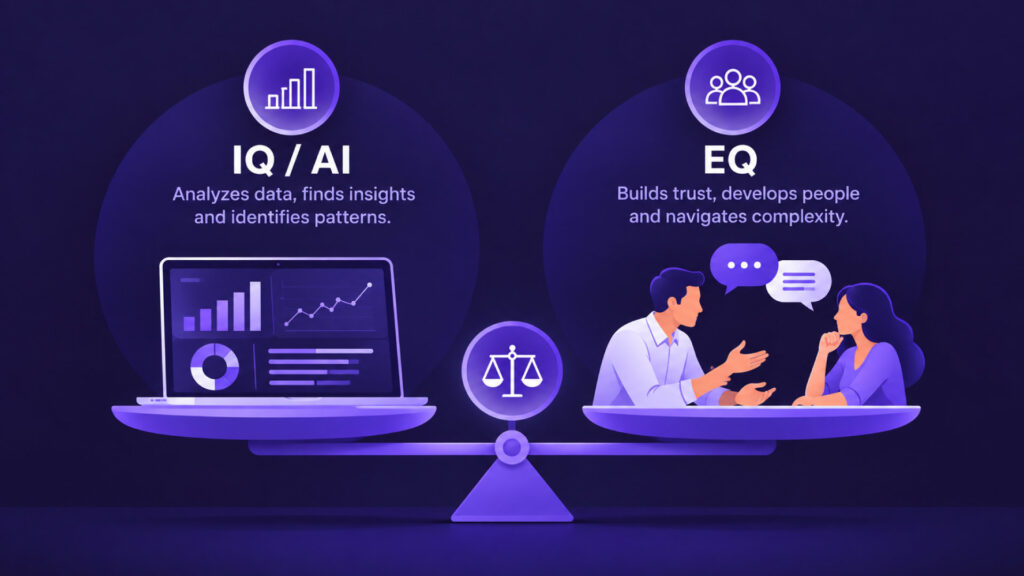
AI is exceptionally good at the work that used to differentiate smart companies from average ones. Data analysis. Pattern recognition. Process optimization. Report generation. Competitive research. These were the IQ tasks, the tasks that rewarded rigor, speed, and analytical precision. And AI does them faster, cheaper, and often more accurately than any human team.
This is not a threat. It is a liberation. But only for organizations that understand what it means.
Because when AI handles the IQ-heavy work, the work that remains is overwhelmingly EQ-heavy. Coaching a struggling team member. Navigating a client through a difficult conversation. Building the kind of trust that makes a team willing to take risks. Reading the room in a negotiation. Making the judgment call that no data set can fully inform.
These are the skills that create competitive advantage in the AI era. And they are the skills that most organizations have systematically undervalued and underdeveloped for decades.
In our recent post this month, I made the case that your AI problem is a people problem. Last week, we explored why AI implementation fails when managers cannot lead. This week, we get to the heart of the IQ x EQ x AI equation: EQ is not just important. In the age of automation, it is the differentiator.
Why Does AI Make EQ More Valuable, Not Less?
Because AI commoditizes the analytical work that used to be a competitive advantage. When every company has access to the same AI-powered insights, the companies that win are the ones whose leaders can do something meaningful with those insights, and that requires emotional intelligence.
Ten years ago, a company that could analyze its customer data faster than its competitors had an advantage. Today, every company has access to AI tools that can analyze customer data in seconds. The advantage has shifted from “who can find the insight” to “who can act on the insight in a way that resonates with humans.”
Ten years ago, a company with the best financial analysts had an edge in forecasting and planning. Today, AI-powered forecasting tools are available to every mid-market company for a fraction of what it cost to build an analytics team. The edge has shifted from “who has the smartest analysts” to “who has the leaders who can make the right judgment calls with imperfect information.”
Ten years ago, the best sales teams were the ones with the deepest product knowledge and the sharpest pitch decks. Today, AI can generate product comparisons, customize presentations, and even draft follow-up emails. The edge has shifted from “who knows the product best” to “who builds the deepest relationships.”
This pattern repeats across every function. Marketing. Operations. Finance. HR. In every case, AI is handling the work that used to require intelligence, and the work that remains requires wisdom, which is intelligence plus empathy, judgment, and human connection.
The World Economic Forum’s Future of Jobs Report 2025, built on responses from more than 1,000 employers representing over 14 million workers, asked which skills will matter most by 2030. Analytical thinking tops the list of core skills, with roughly seven in ten employers calling it essential, followed immediately by resilience, flexibility and agility, then leadership and social influence. Technical skills are climbing fast, and AI and big data leads the list of skills rising in importance, but notice the distinction: technical skills are what employers are racing to acquire, while the human capabilities are what they already treat as essential and expect to stay that way. The same report estimates that 39% of the skills workers use today will change by 2030, which is the whole argument in one number. Proficiency in any specific AI tool is a depreciating asset. Judgment, curiosity, and the ability to lead people through change are not.
Key takeaway: AI is not replacing emotional intelligence. It is revealing how underinvested most organizations are in it. The companies that close the EQ gap now will have a structural advantage that AI tools alone cannot provide.
What EQ Skills Matter Most in the AI Era?
Five specific EQ competencies separate organizations that thrive with AI from those that struggle: adaptive communication, psychological availability, judgment under ambiguity, conflict navigation, and coaching for growth. These are not soft skills. They are the hard skills of the AI era.
Adaptive communication. The ability to deliver the same message differently depending on who is receiving it. AI adoption means telling one team member “this will free you for more creative work” and telling another “I understand this feels threatening, and here is how I will support you.” Same initiative, different emotional needs. Leaders who communicate in one mode, whether that is optimism or data, will fail to reach the people who need a different register.
Psychological availability. The practice of being genuinely present in conversations, not just physically in the room. As AI automates more administrative work, the expectation on leaders shifts from “efficient” to “present.” Your team does not need you to process information faster. AI does that. Your team needs you to see them, hear them, and respond to what they are actually experiencing. This requires attention, not automation.
Judgment under ambiguity. AI provides data, but data does not make decisions. Leaders make decisions, and the most consequential decisions happen when the data is incomplete, contradictory, or absent. Should you reorganize the team around AI capabilities? Should you invest in reskilling or hire new? Should you push harder on adoption or slow down and rebuild trust? These are judgment calls that require integrating information with intuition, context, and human understanding. No algorithm can make them for you.
Conflict navigation. AI adoption creates new kinds of conflict. Between early adopters and resistors. Between teams that benefit and teams that feel threatened. Between the speed of technological change and the pace of human adaptation. Leaders who can navigate these conflicts with care and directness (the carefrontational approach) create the conditions for productive disagreement rather than divisive resistance.
Coaching for growth. The most critical EQ skill in the AI era is the ability to help people develop new capabilities. Not through training programs, but through ongoing coaching conversations that identify where someone is, where they need to go, and what support they need to get there. This is the practical application of the leadership development system we explored in September, now applied to the specific challenge of AI-era skill development.
Key takeaway: EQ is not one skill. It is a set of specific, learnable competencies that determine whether leaders can navigate the complexity of AI adoption. These are the skills that belong in every leadership development program, and they are the skills most programs have historically ignored.

How Do You Build EQ Into Your Leadership Culture?
You build it the same way you build any capability: through selection, development, reinforcement, and measurement. EQ is not a personality trait. It is a skill set that can be systematically developed when organizations commit to it.
Selection: Hire and promote for EQ, not just IQ.
Most hiring and promotion processes are biased toward analytical skills, technical competence, and track record of results. These are IQ measures. Add EQ assessment to your selection criteria:
- How does this candidate handle conflict in real time?
- Can they describe a time they supported someone through a difficult transition?
- How do they respond when they do not have all the answers?
- Can they adjust their communication style for different audiences?
These questions are not soft. They are predictive. Leaders who score high on EQ measures consistently outperform on team retention, engagement, and performance. Our Precision Interviewing workshop can assist you here:
Development: Practice EQ in real situations, not simulations.
The best EQ development happens on the job, not in a classroom. Create structures that give managers opportunities to practice:
- Coaching conversations after difficult team interactions
- Peer feedback circles where managers share how they handled emotionally complex situations
- One-on-one debriefs after AI adoption conversations with their teams
- Mentorship from senior leaders who model EQ consistently
Reinforcement: Make EQ visible in your reward systems.
If you promote people who hit their numbers but leave a trail of burned-out, disengaged team members, you are telling your organization that EQ does not matter. Align your recognition and promotion criteria with EQ behaviors. Celebrate the leaders who retain their teams through transitions. Recognize the managers who develop future leaders. Make it clear that results delivered without care are not the results you want.
Measurement: Track EQ outcomes, not just activities.
- Employee experience scores at the team level (the best proxy for manager EQ)
- Voluntary turnover rates by manager (especially during periods of change)
- AI adoption rates by team (a direct measure of whether the manager is leading the transition effectively)
- 360 feedback scores on specific EQ behaviors
How well does your leadership approach align with the culture you need for the AI era? Download the Cultural Alignment Resource to assess the gap between your stated values and your daily leadership practices. The gap is where EQ development needs to focus.
“AI can process information faster than we ever will, but it cannot care about the person sitting across from you. EQ is where trust, judgment, empathy, and human connection live—and in the age of AI, those aren’t soft skills. They are your competitive advantage.”
Key takeaway: EQ is infrastructure, not decoration. The organizations that build EQ into their selection, development, reinforcement, and measurement systems will have a competitive advantage that no AI tool can replicate. The ones that do not will have the technology and lack the leadership to make it matter.
The IQ x EQ x AI = Designed to Care™ Competitive Advantage
Here is the business case in one paragraph. Companies with high-EQ leadership cultures adopt AI faster because their people trust leadership through the transition. They retain talent better because employees feel supported, not threatened. They innovate more because their teams feel safe to experiment. And they outperform on every metric that matters because the work AI cannot do, the human work, is the work their leaders are exceptionally good at.
This is not theory. It is the pattern that emerges when you look at the organizations that are genuinely succeeding with AI, and compare them to the ones that are struggling. The technology is the same. The tools are the same. The difference is the people, and specifically, the leaders.
The IQ x EQ x AI equation is a multiplier. High EQ does not just add to the equation. It multiplies every investment you make in IQ and AI. And low EQ does not just subtract. It diminishes every other investment.
Next week, we close this month’s series with a synthesis: what a Designed to Care™ organization looks like in the AI era, and why building one is the single most important strategic decision you can make right now.
Connect with Kathleen for your next leadership event
FAQ
Q: Is EQ really more important than technical AI skills?
For leaders, yes. For individual contributors, both matter. But the bottleneck in most organizations is not technical capability. It is leadership capability. Your data scientists and AI engineers need strong technical skills. Your managers and executives need strong EQ skills to create the environment where technical talent can thrive. Most organizations over-invest in technical upskilling and under-invest in leadership development. Rebalancing that investment is one of the highest-ROI decisions you can make.
Q: Can EQ really be developed, or are some people just naturally better at it?
Some people have a natural baseline advantage in empathy, self-awareness, or communication. But EQ is a skill set, not a personality type. Every component of EQ, from active listening to conflict navigation to adaptive communication, can be practiced and improved. The research on this is clear: EQ is developable at any career stage. What it requires is intentional practice, honest feedback, and organizational reinforcement.
Q: How do we convince our executive team that EQ matters for AI adoption?
Use the data. Show them that AI adoption rates correlate with manager effectiveness. Show them that voluntary turnover during AI transitions is highest in teams with low-EQ leaders. Show them that the organizations leading in AI adoption are the ones investing in people leadership, not just technology. And show them the IQ x EQ x AI equation: any investment in AI is multiplied or diminished by the EQ of the leaders deploying it. The business case is not soft. It is mathematical.
Q: What is the fastest way to improve EQ across our leadership team?
Start with coaching, not training. Pair every manager with a coaching relationship, either internal or external, focused specifically on EQ behaviors in the context of real situations they are facing. This produces faster behavioral change than any classroom program because it is immediate, personal, and actionable. Supplement with peer coaching cohorts where managers share challenges and learn from each other. Measurable improvement typically begins within 90 days of consistent coaching.